back to top
Home Blog Page 7

Recommended Gaming Gadgets For Pc Gamers

0

Introduction

In 2024, gaming has reached unprecedented heights, showing no signs of decline. Over time, the gaming community has expanded into a massive industry within the tech world, becoming one of the largest globally. As a result, each year sees the release of new advancements in technology and gadgets, enhancing players’ gaming experiences across various genres, from first-person shooters to online casino games, regardless of the cost.

This article will explore top-tier gaming gadgets available for enhancing your gaming experiences in 2024, enabling you to stay ahead of the curve and maximize your gaming advantages.

Here Are The Recommended Gaming Gadgets For Pc Gamers

Must Read:Top 5 Recommended Steam Games To Buy With A Steam Gift Card

Headset – Recommended Gaming Gadgets For Pc Gamers

Wireless game headset

A crucial component of any gaming setup is a high-quality headset. In most games, sound cues are vital for identifying enemy locations and directions, making a good headset akin to having extra eyes at the back of your head and can significantly impact your chances of success.

Today, headsets come in a wide range of prices, from as low as $13 . While higher prices often indicate better quality, there are numerous affordable options available that still offer excellent performance. For gaming enthusiasts, investing in a headset is essential.

Controller

Game Controller

Gaming controllers have long been essential to players’ gaming experiences and remain one of the most crucial pieces of tech used during gameplay. It’s paramount to have a responsive controller of good quality nowadays. Since all your actions are routed through the controller, optimizing your chances of winning necessitates having a top-notch controller.

Similar to headsets, controllers come in a wide price range, from affordable unbranded options to high-end elite or pro controllers that offer full customization, including button layouts and extra triggers, tailored to your preferences.

While this can be expensive, we recommend getting a decent controller, as a better, more well built controller is also more likely to last longer, meaning you won’t be buying twice and spending more in the long run.

Mouse and keyboard

If you prefer not to use a controller, another alternative is using a keyboard and mouse. Typically favored by PC players instead of controllers like those used by console players, the keyboard and mouse offer greater flexibility in terms of playing style, albeit with a steeper learning curve.

Gaming keyboards and mice are available in various shapes, sizes, and price ranges, with each one being unique. It’s advisable to conduct thorough research before investing, as high-end gaming keyboards and mice can command a significant price tag.

Speakers

Gaming speakers play a crucial role in providing an immersive gaming experience. While headphones are popular for individual gameplay, gaming speakers enhance group gaming sessions and allow for a more social atmosphere. They provide spatial audio cues that can help players pinpoint the direction of in-game sounds, improving situational awareness and overall gameplay performance. Additionally, gaming speakers offer richer audio quality, allowing players to fully appreciate the game’s soundtrack, sound effects, and dialogue. Whether it’s the rumble of explosions in an action-packed shooter or the subtle ambiance of a fantasy world, gaming speakers bring games to life in a way that headphones cannot, making them an essential component of any gaming setup.

Monitor

game Monitor

Arguably, one of the most important components you’ll use while gaming is the monitor. This is one piece of technology we strongly advise against skimping on, as having a quality monitor can truly elevate your gaming experience. We recommend opting for a monitor with at least a 120Hz refresh rate, which ensures smoother visuals.

Monitors are likely to be one of your most significant investments, so it’s crucial to thoroughly research before making a purchase. With numerous brands, sizes, and models available, take your time to explore the options and find the best fit for your gaming setup.

Extra – Desk and chair

Desk and chair

A comfortable desk and chair are essential for an optimal gaming experience. Considering the potentially long hours spent sitting (trust me, I’ve been there!), having a comfortable chair can significantly enhance your gaming sessions.

Whether you opt for an office chair or a dedicated gaming chair, it’s important to ensure that the chair’s height aligns with your desk to prevent any discomfort. Investing in a comfortable chair allows you to enjoy your gaming gadgets for extended periods, as you’ll be able to sit at your desk comfortably for longer durations.

Conclusion

Gaming is an activity that offers enjoyment to all, but for newcomers, it can also seem intimidating. However, with proper research and planning, you can prepare your gaming setup to handle any game or occasion.

Your gaming setup doesn’t need to be extravagant or costly, just functional and efficient. Once you have the essentials, you can gradually upgrade items according to your preferences.You can get these gaming gadgets from Aliexpress.

After reviewing the recommended must-have gadgets for your gaming setup mentioned above, which one do you plan to acquire first?

How A Great Social Media Presence Can Help Grow A Startup

1

Introduction

Social media serves as a dynamic bridge, linking individuals and opportunities, especially beneficial for startups. By harnessing its potential, startups can enhance their presence, cultivate a community, foster meaningful engagements, and unlock pathways to previously inaccessible growth. These platforms are invaluable for engaging audiences and leaving a lasting impression, transitioning individuals from casual observers to devoted patrons. However, to maximize its benefits, precision and caution are imperative. In this guide, we’ll outline eight potent strategies to capitalize on the influence of social media, propelling your startup into a beloved and trusted brand.

Here Are 8 Ways A Great Social Media Presence Can Help Grow A Startup

Must Read:Strategic Ways To Build A Positive Working environment

1. Draw Attention To Your Product

Social media operates on the principle of “seeing is believing.” When guiding leads towards conversion, there’s no better approach than demonstrating your product’s capabilities firsthand. This strategy focuses on vividly showcasing your product, rendering it tangible and irresistible. Here’s a breakdown of how to utilize social media effectively to exhibit your product:

  • Videos are your best friend here.
    • Craft content that showcases your product in action.
    • Think of it as a virtual demo – highlight its features, show how it works, and why it’s a must-have.
    • The goal is to answer any questions a potential customer might have, just by watching.
  • Choose the right platform for your audience.
    • If your product needs a detailed explanation, YouTube is a great choice for longer, in-depth videos.
    • For a younger audience, short and snappy demonstrations on TikTok or Instagram Reels can be very effective.

2. Earn Credibility with Partnerships

Trust holds immense value, establishing credibility can greatly accelerate your startup’s expansion. Strategic collaborations with reputable individuals or organizations can imbue your brand with the authenticity and trustworthiness it requires. Here’s a guide on leveraging social media to earn credibility:

  • Look for individuals or organizations that align with your brand’s values and appeal to your target audience. The key is relevance and respectability.
  • Whether it’s through posts, stories, or videos, make sure the content resonates with your audience and genuinely portrays the benefits of your product.
  • Frame your partnerships in a narrative that your audience can relate to. Show how your product fits naturally into the lifestyle or professional sphere of your partner.

3. Social Proof

Social proof has to do with showing or proving to potential customers that your product or service is esteemed and relied upon by others. When individuals observe the satisfaction of others with your brand, their inclination to trust and select your offering increases. Trust us, nearly all of them peruse your online reviews. Therefore, why not harness this element to your advantage? Here’s a guide on utilizing social media to highlight social proof:

  • Regularly update your social media with positive reviews and high ratings. Let your audience know that others have had great experiences with your brand.
  • If your brand is used by well-known companies or personalities, make sure to highlight these partnerships. This adds credibility and positions your product in a more aspirational light.
  • When customers post about your product, share it. This shows real-life usage and builds a community feeling. It’s a vote of confidence from those who have experienced your product first-hand.

Lanteria, a platform for HR management, skillfully employs social proof on their Facebook page by highlighting customer reviews, proudly exhibiting an impressive 5/5 rating that instantly enhances their credibility. On LinkedIn, they elevate their approach by showcasing prestigious clientele such as Warner Bros., Lufthansa, and Leica, further solidifying trust and positioning Lanteria as the preferred choice among top-tier companies.

Fi, a brand specializing in smart dog collars, adopts a different strategy by leveraging user-generated content. They repost tweets from satisfied customers, showcasing genuine stories and experiences with their products. This tactic effectively transforms their customers into brand ambassadors, offering authentic and relatable social proof that resonates with potential buyers.

4. Drive Traffic to Content

Using social media to channel traffic to your website involves establishing a connection between your social posts and your primary content. This strategy aims to boost visitor numbers while fostering opportunities for deeper engagement, education, and conversion. Here’s a guide on leveraging social media to drive traffic to your website:

  • Your social media content should be eye-catching and compelling, encouraging viewers to want more. Use attractive images, intriguing headlines, or snippets of valuable information to spark curiosity.
  • Every post should have a clear CTA, guiding your audience on what to do next. Whether it’s “Learn more,” “Read our latest news,” or “Discover our collection,” make it easy for them to take the next step.
  • Think of your social media posts as appetizers. They should give just enough to entice your audience, leading them to the main course – your website.

5. Showoff Your Staff’s Credentials and Professionalism

The expertise and professionalism of your team contribute significantly to your brand’s narrative. Displaying their skills and dedication on social media can greatly augment your brand’s credibility and attractiveness. Since people frequently relate to individuals rather than just products or services, this approach can cultivate a more personalized and reliable image for your startup. Here’s a guide on leveraging social media to showcase your team:

  • Share profiles of your team members, highlighting their expertise, experience, and achievements. This can be through dedicated posts, stories, or a special section on your social media page.
  • Share anecdotes or experiences that showcase the skills and professionalism of your team. This could be about solving a customer problem, developing a new product, or anything that illustrates their expertise.
  • Instead of generic stock photos, use real images and videos of your staff. This adds authenticity and helps your audience connect with your team on a personal level.

6. Provide Easily Accessible Customer Support

Providing readily available and conspicuous customer support on social media can substantially enhance your brand’s reputation. Your startup’s expansion is closely linked to being present for your customers, promptly and efficiently addressing their concerns, and answering their inquiries. Here’s a guide on making us of social media for customer support:

  • Ensure your customer service contact details are easy to find on your social media pages. This includes phone numbers, email addresses, or direct message options.
  • Implement chatbots or automated responses to provide immediate interaction. These can guide customers with preset questions or direct them to the right resources while they wait for a human response.
  • Regularly post about how your team has successfully resolved customer issues. Share testimonials or stories of positive customer service experiences.
  • Actively ask for feedback on your support services and make it easy for customers to provide it. This improves your service but also shows that you value customer opinions.

REI, known for outdoor apparel, exemplifies excellent customer support visibility on their Facebook page. They prominently showcase their customer service hotline and incorporate a “Message” button, facilitating instant chat access with preset inquiries.

This seamless interaction feature simplifies customer outreach and ensures swift responses. By prioritizing accessible and visible customer support, REI enhances the overall customer journey, fostering trust and loyalty.

To establish top-tier customer support on social media, it’s insufficient to merely address inquiries. It’s essential to develop a comprehensive support framework that is responsive, dependable, and reassuring. This approach demonstrates to both potential and existing customers your unwavering commitment to assistance, propelling your startup towards success.

7. Develop a Unique Brand Voice

Your brand’s voice represents the unique character it embodies in its communications. It plays a crucial role in distinguishing your brand, making it relatable, and ensuring it shines amidst the bustling social media landscape. A carefully selected brand voice resonates with your audience, forging a deeper emotional bond. Here’s a guide on leveraging social media to succeed with your distinct personality:

  • Determine the traits that represent your brand. Is it professional, playful, inspirational, or witty? This personality should align with your brand values and appeal to your target audience.
  • Once you’ve established your brand voice, use it consistently across all your social media platforms. This consistency helps in building brand recognition and loyalty.
  • Ensure everyone involved in your social media content creation understands and can effectively use your brand voice.
  • Use your brand voice not just in your posts but also in your interactions with customers. Replies, comments, and messages are all opportunities to reinforce your brand personality.

Fitbit, a prominent player in the fitness tech realm, exemplifies a brand with a distinctive voice. Renowned for their light-hearted and humorous tone, they infuse a sense of enjoyment and approachability into fitness technology. Whether on platforms like Instagram, Facebook, Twitter, or TikTok, Fitbit’s content often incorporates wit, resonating effectively with their audience.

This strategy has yielded impressive engagement rates on their posts. By adopting a light-hearted approach, Fitbit cultivates a relatable and welcoming image that appeals to their fitness-oriented audience.

Crafting a unique brand voice involves not just what you say but how you say it, establishing a distinct identity in the digital sphere. It serves as a potent tool for imprinting your brand in the minds of consumers and fostering an emotional connection with your audience.

8. Establish Relationships Through Interactions

Customers may come and go, but cultivating a loyal base requires meaningful interaction. Establishing relationships with your audience through personal conversations on social media can convert followers into dedicated advocates. Creating a dialogue where your audience feels heard, valued, and connected to your brand is key. Here’s a guide on leveraging social media to foster strong relationships:

  • Timely responses to your audience’s comments and direct messages are super important. It shows that you value their input and are attentive to their needs.
  • Don’t just respond – engage. Start and participate in conversations. Ask questions, solicit feedback, and show genuine interest in what your audience has to say.
  • Whenever possible, personalize your responses. Use their names, refer to previous interactions, and make each response feel tailored and special.
  • Sharing content created by your audience, such as photos or stories of them using your product, is a great way to acknowledge and appreciate them.

Conclusion

Making use of these social media strategies can transform your startup’s online presence into a potent catalyst for growth. Our suggestion is to not solely depend on metrics—they’re merely statistics. What truly counts is constructing a brand that strikes a chord with individuals and nurturing a community that stands by you and evolves alongside you. Through the adoption of these tactics, you’ll soon witness a tangible upsurge in your startup’s prosperity while forging enduring connections that transcend the digital realm.

7 Must Have Resources Before Starting Your Own Business

0

Introduction

If there’s a lesson the COVID-19 pandemic  taught us is that virtually anything can be conducted online, including launching a business venture. If you have a concept in mind and a clear understanding of what you want to provide or sell, you’ve tackled a crucial aspect of the journey. If not, explore potential side hustles or business concepts online, or brainstorm with your friends and acquaintances. However, the true journey begins after the initial idea generation phase.

How To Get Started

Many entrepreneurs find themselves at a standstill during this phase, unsure of where or how to initiate their business operations. While a Google search can offer a broad outline of the process, it often overlooks crucial details. Fortunately, numerous business schools cater specifically to aspiring entrepreneurs, providing comprehensive guidance on launching and overseeing your venture. In this blog post, we’ll delve into the essential resources you need to kickstart your business journey. Let’s get started!

Here Are 7 Must Have Resources Before Starting Your Own Business

Must Read:4 Tools You should Use in Your Organisation to Help Your Business Work Smarter

1. Resources on Planning

Resources on Planning

No need for uncertainty. Embarking on planning marks the foremost step. It stands as the pivotal component of commencing a business, offering a comprehensive overview of the venture’s essence and its potential viability.A business plan also:

  1. Sets your vision and mission.
  2. Charts out the kinds of products and services you’ll offer.
  3. Analyzes the kind of seed money you’ll need.
  4. Creates a budget for expenses.
  5. Outlines the human resources you’ll require, if any.
  6. Markets your products and services.
  7. Plans out how to retain customers to sustain your business.

You can start doing all the above on your own or get help from professional bureaus like Small Business Administration (SBA), or use tools like Bplans, SCORE, and Shopify.

2. Resources on Market Research

Resources on Market Research

Although your idea and planning might be solid, and even if you believe there’s a substantial customer base, the crucial aspect lies in identifying the precise customers willing to purchase your offerings. Market research plays a vital role in this endeavor. Utilizing resources such as Statista, Pew Research Center, Census Bureau, SBA, and survey tools like SurveyMonkey can provide detailed insights through comprehensive market analysis.

3.  Legal Resources

Prior to commencing operations, it is essential to ensure your business is officially registered. This is particularly crucial for businesses engaging in physical interactions with customers within and around the city, especially those involving physical product delivery or service provision. Registering your business involves two key aspects: compliance with tax regulations and safeguarding intellectual property rights. Seeking guidance from a lawyer or utilizing resources can be beneficial. Additionally, online platforms offer assistance with legal matters including trademarks, incorporation, partnerships, and sole proprietorship. Obtaining a license enables you to open a business account and apply for permits required for specific business types.

4. Financial Resources

With all the necessary paperwork completed, you can now turn your attention to securing funding for launching your business. The financial requirements vary significantly based on the nature of your venture. For instance, an online content writing service can be initiated with minimal investment, with you as the sole employee. Conversely, businesses like food delivery or salon services necessitate substantial investment for expenses such as renting a space, stocking inventory, and hiring staff. If you have personal savings available, you may not need to seek external funding immediately. However, it’s prudent to explore options for seed money to bolster your resources for unforeseen circumstances. Various resources are available for researching and applying for seed funding, including:

  • Friends and family can help gather funds.
  • Grants from government agencies 
  • Crowdfunding/fundraising events  
  • Startup accelerators like Paritie Innovation Hub.

There are tons of financial resources out there, but these will get you started.

5. Resources on Marketing Strategy

Establishing awareness for your business necessitates a robust marketing strategy and an outlined approach to engage with your target audience. From crafting a logo to forging a brand identity, and pinpointing the appropriate media and platforms for launching marketing initiatives, organizing marketing endeavors is imperative. Resources such as Hubspot Academy, Facebook, SEMRush, Hootsuite, and Mailchimp can offer insights into the essentials of commencing a digital marketing campaign. Alternatively, platforms like Canva (for quick template-based designs) and ZillionDesigns (for customized designs by professionals) provide avenues for acquiring professional branding materials. The objective behind securing these assets is to create an initial positive impression on your audience, captivating their interest and curiosity about your brand.

6. Resources on Networking

Resources on Networking

While online marketing endeavors play a crucial role in garnering publicity, it’s equally essential to engage with real people through networking efforts. Traditional networking events such as meetups, support groups, business gatherings, and fairs serve as excellent starting points. You can consider affiliating with governmental organizations . If feasible, securing a stall at events to promote your business, despite its typically high cost, can be advantageous as it provides an opportunity to interact directly with potential customers. Make the most of these interactions by delivering compelling pitches and showcasing your products and services effectively. When attending networking events focused solely on building connections, prioritize engaging with individuals who are likely to benefit from your expertise. During such interactions, aim to share information about your business without directly selling. To maximize the benefits of networking events, actively interact with attendees and endeavor to collect their contact information for future outreach.

7. Resources on Productivity

Resources on Productivity

Prior to the acceleration of business operations, it’s advisable to prepare for your workflow and management approach. If you’re initiating the venture solo, establishing productive work hours for business-related tasks becomes more manageable. Tools such as Focus, Todoist, Google Sheets, Trello, and Kanban can serve as effective starting points. As your team expands, incorporating collaboration platforms like Microsoft Teams, Zoom, Asana, Slack, and Evernote facilitates task assignment, tracking, and communication.

Conclusion

While this compilation is not comprehensive, the mentioned tools can offer invaluable assistance. Additionally, management platforms like Monday.com, FreshBooks, and similar tools are crucial. Ultimately, you are the best judge of what your business requires. As a startup entrepreneur, endeavor to minimize expenses by exploring and going for freemium or affordable alternatives rather than investing in full-scale platforms that could strain your budget.

How To Protect Your Game Server from DDoS Attacks

Introduction

In recent years, gaming has surged in popularity, drawing more individuals to indulge in gaming sessions after work or during weekends. The landscape has evolved notably, with a substantial shift towards gaming on specialized servers. These servers, available for rent or creation by game administrators, companies, or players, allow the installation of various games. However, a pressing issue has risen: gaming servers have increasingly become prime targets for DDoS attacks. In this article, we delve into the reasons behind this trend and offer insights into safeguarding your server and gaming experiences from such attacks.

Must Read:Top 5 Recommended Steam Games To Buy With A Steam Gift Card

Why Gaming Servers Are A Prime DDos Target

Why Gaming Servers Are A Prime Ddos Target

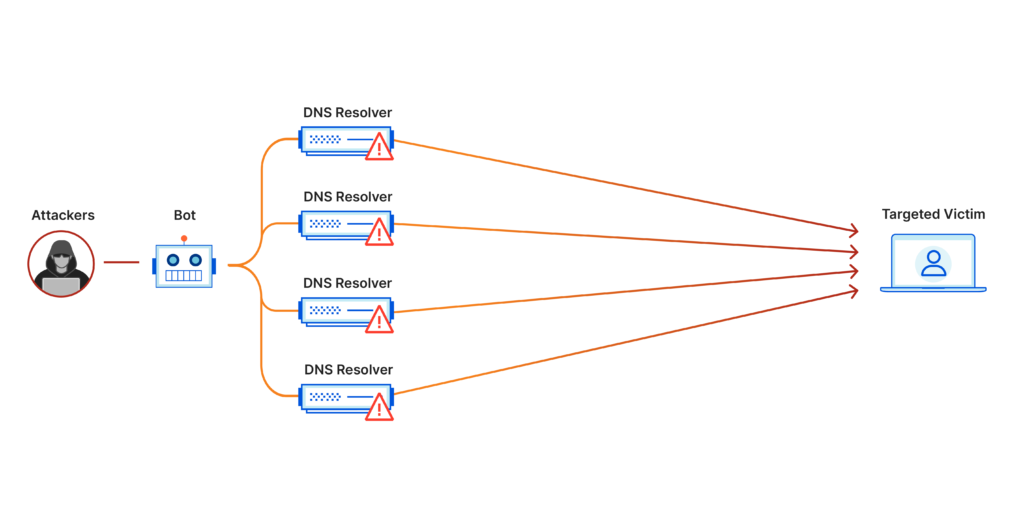
Firstly DDoS is short for distributed denial of service.These servers are particularly vulnerable to malicious attacks primarily due to their high performance. Modern games demand substantial hardware resources to operate smoothly, especially when accommodating numerous players simultaneously, ranging from a few dozen to thousands. This heightened performance renders them attractive targets for viruses seeking to exploit their capabilities to swiftly spread through networks. Given that these servers are interconnected with other servers and users’ devices, there’s a risk of these viruses infiltrating additional systems.

In addition, gaming servers are prime targets for malicious actors seeking to deploy cryptocurrency mining trojans and malware. These threats can infiltrate either the server itself or any device connecting to it. Consequently, a single DDoS attack can result in the infection of hundreds or even thousands of devices. Furthermore, within the industry, there’s fierce competition. With competitive online gaming evolving into a billion-dollar industry, many companies vie for a larger player base on their servers. They recognize that organizing tournaments or events requires a sufficient player count, prompting them to hinder rival servers through DDoS attacks.

Set Yourself Up For Success

For gamers well-versed in server setup and equipped with the necessary knowledge, establishing a gaming server fortified against DDoS attacks is feasible. However, individuals lacking this expertise may find the task daunting. Rather than grappling with the complexities associated with implementing DDoS protection, opting to collaborate with specialized companies proves advantageous. These entities integrate game DDoS mitigation and protection measures into gaming servers to shield them from potential attacks. Additionally, they furnish users with a comprehensive control panel, offering real-time insights into server activities, along with round-the-clock access to proficient customer support teams for prompt issue resolution.

Protecting Your Server Using A Firewall

Should you opt for self-setup, your initial priority is configuring a firewall. By default, it should block all incoming traffic since DDoS attacks inundate your system with excessive data, crippling its functionality. During setup, it’s imperative to establish exceptions permitting access to essential ports and protocols for server login, SSH, and game connectivity (TCP/UDP). Strengthening these rules involves restricting access solely to specific IP addresses for login protocols and ports. However, ensure your IP address is static, not dynamic, to prevent access issues caused by IP changes. Dynamic IP addresses fluctuate, potentially locking you out of your account or server if changes occur after setting up these rules.

Use Rate Limiting To Protect Your Server From DDoS Attacks

The optimal approach is to safeguard your server using rate-limiting techniques. While a firewall offers protection against incoming requests, it still leaves vulnerabilities that malicious actors can exploit. Rate limiting addresses this concern effectively.

As its name implies, rate limiting restricts the number of requests the server can handle within a specified timeframe. This capability makes it a powerful tool against DDoS attacks. Beyond merely capping the request count, rate limiting can also regulate the time frame within which requests are processed. This time window can span from as short as one second to extending over a day. During a DDoS onslaught, requests may flood in at rapid intervals, overwhelming the server. By limiting the time window, some of these requests are thwarted, mitigating their impact on the server’s performance.

Applying Rate Limiting On Different Levels

Rate limiting offers versatility by allowing implementation at various levels. Within the application’s code, built-in rate limiting functionality monitors incoming requests and enforces limits according to predefined rules.

Moreover, it can be integrated at the server level. Server software such as Apache and Nginx provides tools for applying rate limiting based on specific criteria, including headers, URLs, and IP addresses. These rules enable the banning of IP addresses exceeding request thresholds, resulting in a 403 (forbidden) or similar error response.

If the game server utilizes APIs, rate limits can also be set for these endpoints. Additionally, rate limiting can be applied at the reverse proxy level. Many game servers employ a reverse proxy positioned in front of the application server, acting as a gatekeeper to filter and manage incoming traffic.

Strengthen Your Server Configuration

Your firewall and rate-limiting configurations provide a solid defense against minor attacks, but further hardening measures are necessary for more severe threats. This entails closing unused ports, deactivating unnecessary services, and ensuring secure connections and communications.

Additionally, enabling automatic server updates is crucial despite these security measures. This ensures the operating system and server software remain current with the latest security patches.

Bear in mind that malicious actors continuously monitor changelogs to identify vulnerabilities patched by developers, particularly in older software and operating system versions.

Conclusion

The strategies outlined above can greatly minimize the impact of DDoS attacks. Nonetheless, maintaining vigilance is essential to detect and address any emerging issues, as complete risk elimination is difficult given the constantly evolving landscape of cyber threats. Collaborating with cybersecurity professionals is advisable to explore further methods of ensuring the safety of your gaming server and its users.

Top 5 Recommended Steam Games To Buy With A Steam Gift Card

1

Introduction

Are you a fan of PC gaming? Steam offers a vast selection of top-notch PC games. In this guide, I’ll highlight the top 5 games available on Steam that you can purchase with a Steam gift card. With so many games on the platform, navigating through them can be overwhelming. That’s why I’ve curated this list to make it easier for you. Whether you received a Steam gift card as a present or bought one yourself, you can use it to indulge in your favorite PC games. If you’re in need of a Steam gift card, Nosh has you covered. Whether you’re into Role Playing Games, First Person Shooters, action-packed adventures, or other genres, this list has something for everyone. Let’s dive in!

Here Are The Top 5 Recommended Steam Games To Buy With A Steam Gift Card

Must Read:The Top 7 Best Gaming Keyboards in 2024

Monster Hunter WorldTop 5 Recommended Steam Games

Monster Hunter World

In this action-packed role-playing game, you’ll step into the shoes of a hunter tasked with journeying to a mysterious new world to hunt down formidable monsters. Utilize the diverse landscape and inhabitants of the new world to enhance your chances of victory. Defeating the initial monsters grants you access to materials needed to craft even more powerful weapons to take on stronger foes. As you advance, the challenges become more formidable, promising plenty of surprises and thrills along the way. Brace yourself for an adventure filled with excitement!

The Witcher 3: Wild Hunt

The Witcher 3: Wild Hunt

If you’re familiar with the tv series “The Witcher,” you can envision your role in the game. It’s a role-playing adventure where you step into the shoes of Geralt. Your primary objective is to confront Ciri, known as the Child of Prophecy, who possesses the potential to bring significant upheaval to the world.

Resident Evil 4

Capcom developed this game as a survival horror experience. If you’re a fan of horror movies, it’s an excellent choice. The player takes on the role of Agent Leon Kennedy, tasked with rescuing the daughter of the US president. However, the European village where she’s located is overrun by parasite-infected locals, adding an intense layer of challenge to the mission.

Fire Pro Wrestling World

True to its name, Fire Pro Wrestling World is a professional wrestling video game. Players have the freedom to customize various elements such as the wrestling ring, wrestler character, referee, mat logos, and more. The ultimate objective is to claim victory and secure the championship belt.

Red Dead Redemption 2

Red Dead Redemption 2

Players take command of Arthur Morgan, the central character in this game. Following a failed robbery in the western town of Blackwater, Arthur and his gang find themselves on the run. Their journey involves multiple heists and skirmishes as they clash with federal agents and bounty hunters in their struggle to survive.

How To Use Steam Gift Card To Buy Games

  1. Log into your Steam account. If this is your first time, you can create an account and then sign in.
  2.  Tap your account name and choose Account Details from the displayed list.
  3. Tap on ADD FUNDS TO YOUR STEAM WALLET.
  4. Click on REDEEM A STEAM WALLET CODE”.
  5. Input your Steam gift code.
  6. Click on Redeem and the balance will be added to your Steam wallet. 
  7. You can then browse your favorite games on Steam and use the Steam wallet as a payment method. 

Conclusion

In conclusion, the top Steam games available for purchase with a Steam gift card are , Monster Hunter World, Resident Evil 4, The Witcher 3: Wild Hunt, Fire Pro Wrestling World, and Red Dead Redemption 2.

By following the steps provided in this guide, you can effortlessly use your Steam gift card to acquire any of these titles.

Additionally, if you’re located in Nigeria you have the option to exchange your Steam gift card for cash. Nosh, a gift card trading platform, facilitates trading gift cards for naira or dollars.

Learn How To Make A Newsletter

Introduction

Creating a newsletter presents a potent opportunity to engage with your audience, disseminate valuable content, and enhance your brand’s exposure. Regardless of whether you’re a corporation, a non-profit entity, or an individual with a narrative to share, a meticulously crafted newsletter can serve as a powerful tool for fostering meaningful connections within your community. This guide will outline the essential steps to develop a newsletter that not only boasts an appealing design but also deeply resonates with your readership.

What Is a Newsletter?

A Newsletter

Sent typically through email, a newsletter is periodic publication designed to keep subscribers informed about news, events, and topics pertinent to a particular subject or organization. Integral to digital marketing strategies, they differ from direct promotional emails by frequently featuring succinct articles that provide valuable insights into a company’s offerings, services, and values.

Published on a weekly, monthly, or quarterly basis, newsletters facilitate ongoing communication with email subscribers. An efficient newsletter endeavors to both inform and engage its audience, thereby assisting in the conversion of potential customers into active buyers.

Why Is a Newsletter Important?

Beyond mere communication, a newsletter serves as a potent instrument for engaging and nurturing your audience, acting as a vital link between your brand and your consumers. It offers a direct conduit to disseminate valuable content. Below are the primary advantages:

  • Builds and strengthens customer relationships.
  • Enhances brand awareness and loyalty.
  • Drives website traffic and sales.
  • Positions your brand as an industry thought leader.
  • Provides a platform for personalized marketing.
  • Increases audience engagement through tailored content.
  • Offers measurable insights into customer preferences and behavior.
  • Facilitates consistent communication with your audience.
  • Encourages direct feedback from subscribers.
  • Supports promotional and marketing efforts effectively.

Steps to Make a Newsletter

A newsletter packed with valuable content and adeptly customized to connect with your audience can greatly enhance both relationship development and conversion rates. Keeping this in mind, let’s explore the important steps to craft an exceptional newsletter.

Must Read:4 Tools You should Use in Your Organisation to Help Your Business Work Smarter

1. Determine Your Purpose 

Initiate the process by contemplating the primary objective of your newsletter. This initial step involves more than just outlining the content; it also entails grasping the underlying intention behind your communication. Are you aiming to enlighten your readers about industry trends, educate them on particular subjects, introduce and advertise your products, or cultivate an interactive and captivating relationship with your audience?

2. Define Your Target Audience

This stage entails a comprehensive examination of your target audience. Explore their demographics, interests, professional backgrounds, and their preferences for newsletter content. Do they desire expert insights, industry updates, practical advice, or exclusive deals? Grasping these subtleties enables you to customize your content to align with their expectations and preferences, ultimately enhancing engagement and relevance.

3. Choose a Newsletter Platform

The choice of platform can significantly influence the efficacy of your newsletter. Platforms such as Mailchimp, Constant Contact, and Substack provide various features, but the crucial factor is selecting one that aligns with your technical proficiency and the particular requirements of your campaign. Evaluate factors such as ease of template customization, analytics for monitoring engagement, and overall user-friendliness. The ideal platform should streamline your workflow and amplify the impact of your newsletter.

4. Build a Subscriber List

Creating a subscriber list goes beyond simply gathering email addresses; it’s about extending invitations for individuals to become part of a community where they can derive value. Utilize your website, social media platforms, and other digital channels to attract subscribers. Ensure compliance with privacy regulations such as GDPR or the CAN-SPAM Act while implementing these methods.

5. Design Your Newsletter Template

The design of your newsletter holds immense importance as it’s the initial aspect your readers will observe. Guarantee that your template mirrors your brand identity by maintaining consistent usage of logos, colors, and fonts. The layout should be uncluttered, visually enticing, and adaptable for mobile devices, considering a substantial portion of users will access it via their smartphones or tablets.

6. Plan Your Content Strategy

As you prepare and brainstorm content ideas, it’s advisable to develop a content strategy simultaneously. Consistency is key, so ensure you are well-prepared in terms of execution. Here’s a brief overview of an effective strategy:

  • Determine Frequency: Decide how often you’ll send your newsletter. Will it be weekly, monthly, or quarterly? Balance your ability to produce quality content with your audience’s appetite for information.
  • Assess Audience Interests: Understand the varied interests of your audience. This will guide the diversity of your content.
  • Select Content Types:
    • Articles: Deep dive into relevant topics.
    • Updates: Sharing the latest news or changes in your domain.
    • Promotions: Highlighting new products or special offers.
    • Insights: Offering unique perspectives or expert opinions.
  • Develop an Editorial Calendar: Plan when each type of content will be featured. This helps in maintaining a balanced and varied content flow.
  • Review and Adjust: Regularly evaluate the response to your content and adjust your strategy accordingly to keep your newsletter engaging and relevant.

7. Write Engaging Content

The core of a newsletter lies in its content. Aim to craft pieces that are not only informative but also captivating and stimulating. Additionally, employ a tone that directly resonates with your audience, while maintaining clear and concise language.

8. Use Eye-Catching Headline

One of the pivotal components of an effective newsletter resides in its headlines. A meticulously crafted headline should swiftly capture your reader’s attention and provide compelling reasons for them to continue reading. Rather than showcasing your writing skills, prioritize connecting with your audience by addressing their interests and requirements. Craft headlines that are both intriguing and valuable, enticing readers to explore the contents of the newsletter. This approach ensures that they discover the valuable insights and information you intend to share. Remember, a headline transcends mere titling; it serves as an invitation to showcase the benefits readers can derive from your newsletter.

9. Include Visual Elements

A newsletter overloaded with text can be overwhelming, as not everyone possesses the attention span of a Zen monk. Therefore, intersperse relevant and enticing visual elements such as images, videos, infographics, or charts to alleviate monotony. These elements enhance engagement and aid in comprehending complex ideas.

10. Add a Call-to-Action (CTA)

So many individuals struggle to creating a compelling call to action, if they include one at all.

Conclude each newsletter with a seamless transition directing the reader on the next course of action: Visit your website? Dive into a detailed article? Or perhaps complete a brief survey to share their thoughts on your brand? Regardless, always incorporate a call to action to seize the opportunity for potential conversion by prompting readers to take the next steps.

11. Test and Send 

Prior to sending out the newsletter, it’s crucial to test it across various devices and email clients. This ensures that your newsletter appears visually appealing and functions smoothly regardless of how or where it’s viewed. Refine any elements as needed to guarantee a seamless and professional reader experience. Consider sending the content to yourself in a separate email to assess its appearance from the recipient’s perspective.

Measuring the Success of Your Newsletter

Following the dedication invested in crafting and disseminating a newsletter, it’s essential to comprehend its impact. This comprehension is pivotal for refining your strategy for upcoming newsletters. To accurately measure success, delve into the analytics furnished by your email marketing platform. Here’s what you should focus on:

  • Open Rate: This metric tells you how many people are actually opening your newsletter. A high open rate indicates that your subject lines are effective in catching attention.
  • Click-Through Rate (CTR): CTR measures how many readers clicked on links within your newsletter. It’s a strong indicator of how engaging your content is and whether your calls-to-action (CTAs) are compelling.
  • Conversion Rate: This is about how many readers took the desired action, such as making a purchase or signing up for an event. It directly reflects the effectiveness of your newsletter in driving tangible results.
  • Overall Engagement: Look at metrics like time spent on the newsletter, interaction with interactive elements, and social shares. This gives a broader view of how your content resonates with the audience.
  • Subscriber Growth: Track how your subscriber list is growing over time. This can indicate the health and appeal of your newsletter.
  • Unsubscribe Rate: While it’s natural to lose some subscribers, a high unsubscribe rate can signal issues with content relevance or frequency.
Conclusion

Quality content reigns supreme, and email campaigns boast substantial ROI. Therefore, it’s a clear choice to develop a newsletter for your consumer base. Furthermore, a meticulously crafted newsletter serves as a vital instrument in nurturing and strengthening your bond with your audience. It presents an opportunity to disseminate valuable insights, updates, and promotions while reinforcing your brand identity.

FAQs

Is it important to personalize your newsletter?

Yes, personalization can significantly increase engagement and relevance for the reader.

How often should you send out a newsletter?

This depends on your content and audience. Consistency is key, but avoid overwhelming your readers.

How can you grow your newsletter subscriber list?

Offer valuable content, use social media to promote sign-ups, and consider partnerships or promotions to reach a wider audience.

4 Tools You should Use in Your Organisation to Help Your Business Work Smarter

0

Introduction

If you encounter any of the following scenarios, it might be a sign to prioritize organization. Fortunately, there are resources available to assist you.

– Is your work desk overwhelmed with stacks of papers?

– Do you frequently waste time searching for misplaced documents and essential paperwork?

– Are you frequently tardy for or miss critical meetings, appointments, and deadlines?

– Do you feel your productivity is lacking, leading to prolonged work hours?

If yes,then you’re in luck, join us us as we list down 4 tools that will organise and ease your work. 

Why being organised is beneficial to any business or organisation

Maintaining organisational efficiency is crucial for business success amidst a busy schedule. By investing in the appropriate tools and resources, you not only enhance organisation but also unlock various other benefits, fostering growth and prosperity.

  • Increased productivity. Save time you would otherwise waste looking for different documents, projects or tasks. Instead, focus more on what you actually have to do. Plus, you’ll become more efficient in allocating your resources because everything will be organised using your organizational tool of choice. It goes without saying that this will have a positive effect on your productivity and that of your team, helping you get more tasks done.
  • Easier progress tracking and monitoring. With an organisational tool, you’ll have a clear overview of your activities, projects and tasks. Ultimately, this will help you make important business decisions with ease and use your resources better. Plus, if you have team members or employees, it will help everyone stay on track – everyone will have a clear picture of what they’re working on, where they are with their tasks and which tasks should be prioritized.
  • Have everything in one place. Using an organizational tool means you can keep everything related to your business in one place. This goes hand in hand with productivity – with the right tools in place, you no longer have to spend precious time looking for documents; instead, you can spend it actually working on your tasks.

Now, the question is: How do you stay organized? What resources and tools can you use? How can you keep the back end of your business more organized?

Tools to help keep the back end of your business more organized

The goal is to work smarter, NOT harder, so you can focus on the work that you do best. Here are four resources, software and tools that will help you stay organized in 2024

Must Read:4 Recommended Skills Every Business Person Should Master

Trello

trello logo

Trello, a user-friendly organizational tool, offers a generous free plan and boasts an array of ready-to-use templates. From managing editorial calendars to streamlining marketing and sales processes, task assignments, and other business processes, Trello excels in organizing various needs. Here’s a preview of Trello’s capabilities:

  • Organize different projects by creating different boards. Then, provide access permissions to all team members involved in your project.
  • Create and save tasks into cards, attach notes, files and deadlines.
  • Organize tasks per project status by building project status columns, after which you can drag and drop each task card onto a member’s designated column.

Trello is one of the best and most low-cost online organizational tools that you can use to keep the back end of your business more organized.

Asana

Asana stands is an organizational tool which enables you and your team to efficiently organise, manage tasks, and monitor progress. Renowned for its collaborative features, it excels in facilitating teamwork for ongoing and upcoming projects. Here are some functionalities offered by Asana:

  • Manage to-do’s, collaborate with your team members and stay on top of project/task progress all in one place.
  • Create tasks with specific due dates, then organize them into lists to prioritize and organize your work.
  • Track individual tasks, project progress and integrate with other tools for better organization.
  • Post task updates, share team-wide announcements, and collaborate on tasks all in one place.
  • Group tasks into columns or sections in a board project or list to keep tasks organized.

When faced with so many back-end tasks, Asana allows you to delegate them to designated individuals or teams. This approach aids in meticulous task management and ensures everyone remains informed about the project’s status. Additionally, team members involved can conveniently access tasks and track progress from anywhere using the web or mobile app.

Buffer

buffer

Buffer serves as an organizational tool designed for orchestrating and scheduling your social media engagements. Initially conceived as a comprehensive social media management solution, it has since developed and now provides two distinct product offerings:

  • Planning, collaborating and publishing social media posts.
  • Accessing advanced social media analytics and allowing you to generate and create reports.

Buffer equips you with all the essentials to manage your social media profiles effectively and elevate your strategies seamlessly. In today’s fiercely competitive digital landscape, maintaining active social media presence is paramount for businesses. With Buffer, you can collaborate with your team, craft content for Facebook, Twitter, or Instagram, analyze data via a unified dashboard, and gain invaluable insights and statistics on your social media campaigns .

MindMeister

MindMeister

MindMeister serves as an online mind-mapping and work organization tool, facilitating the visual organization of ideas, projects, and workflows. Whether you’re engaged in continuous brainstorming or coordinating diverse tasks and workflows with your team, MindMeister aids in maintaining organization. Its live, online collaboration feature enhances accessibility for remote team members, streamlining processes. Moreover, MindMeister offers a built-in presentation feature, instantly transforming mind maps into slideshows for seamless sharing with your team. Here’s an overview of MindMeister’s capabilities:

  • Visualize, present and share your thoughts via the cloud.
  • Visualize information in mind maps.
  • Create, share and edit mind maps; attach files, images and videos, and leave comments and feedback.
  • Facilitate real-time collaboration, coordinate task management and create presentations.
  • Share task or project updates in mind maps in real time with your team members across in-browser and mobile apps.

For those unfamiliar with mind mapping but interested in exploring a more visual approach to organizing business processes, MindMeister provides training sessions to facilitate your introduction to this method.

Conclusion

These represent just a selection of the numerous tools and resources available to enhance the organization of your business operations in 2024. While each tool has its own set of strengths and weaknesses, it’s essential to consider your specific business and organizational requirements. Ultimately, the most effective method is one that you find usable and sustainable. Take the time to evaluate the pros and cons of each option, selecting the one that aligns best with your preferences and organizational needs.

4 Recommended Skills Every Business Person Should Master

0

Introduction

Do you want to start up your own company? You’re not alone in this pursuit. Nevertheless, not every startup will evolve into a sustainable business venture. To increase your chances of success, it’s necessary to have more than just a brilliant idea. You must cultivate habits that lay the foundation for success.

Successful business owners exhibit specific skill sets and behaviors, such as persistence, risk-taking, financial literacy, innovation, and problem-solving. While some individuals may naturally possess these qualities, they can all be developed through dedicated practice.

Here Are 4 Recommended Skills Every Business Person Should Master

Regardless of whether you’re an experienced entrepreneur or embarking on your business journey, there’s always an opportunity for advancement. Prioritizing skill development before launching your venture can significantly enhance your likelihood of success. Here’s a compilation of essential qualities that every successful business owner should embody.

Must Read:Steps To Setup Up A Safe Crypto Wallet for Your Business

Be proactive

To thrive as a successful business owner, dare to defy conventional norms. Often, it requires a proactive mindset to excel. While a well-crafted business plan and a sturdy foundation are essential for commencement, you must also be willing to dive in wholeheartedly. You may possess an exceptional business concept, but without taking decisive action, your venture won’t flourish.

*Embrace mistakes

There’s no definitive roadmap to business ownership, implying that you’ll likely encounter missteps along your journey. However, what truly counts is how you extract valuable lessons and evolve from those errors.

Expect this journey to be riddled with obstacles. Mastering every aspect takes time, but don’t allow setbacks to overshadow your accomplishments. Embrace mistakes as opportunities for business growth to fortify your enterprise.

Identify your strengths and delegate tasks that aren’t your forte to individuals better suited for the role. This enables you to concentrate on what you can manage while ensuring the smooth operation of your business.

Avoid micromanaging every facet of the company, as it can result in burnout and errors. By entrusting responsibilities, you can offer guidance to your team and discern where you can adopt a more hands-off approach.

*Face fears

Undoubtedly, embarking on a business venture can be scary. Yet, to thrive as an entrepreneur, confronting your fears is essential. While fear serves a purpose, it shouldn’t immobilize you. Instead, harness those fears to drive action. As a business owner, embrace the possibility of failure and continue forward.

Compile a list of your fears and analyze the reasons behind each apprehension. Then, devise strategies to surmount them.

*Take risks

Entrepreneurs often take risks, but this should be approached thoughtfully. Prior to undertaking significant risks, ensure your business is adequately prepared for potential outcomes. Be ready to engage in calculated risks as a pathway to success.

As a business owner, assertiveness, a strong work ethic, and adaptability are crucial traits. Success requires proactive action; no one will accomplish the work for you. Broaden your skill set to gain comprehensive understanding of all facets of your business. Additionally, remain open to collaborating with new individuals and seeking assistance when needed. Embrace novelty without fear.

Seek inspiration

Thriving business owners frequently draw inspiration from various sources. It’s advisable to immerse yourself in environments where people and ideas can contribute positively to your business endeavors.

*Network

Networking serves as a valuable tool for finding inspiration and potential business partnerships. Networking events provide excellent learning opportunities and opportunities to meet fellow business owners who share similar goals.

While networking may not always feel comfortable, it’s essential for business growth, particularly in the early stages. Utilizing social media platforms like LinkedIn or other online forums can be a convenient way to initiate connections.

In-person conferences and events offer ideal settings for forging enduring connections, especially if you’re seeking business partnerships or innovative strategies for startup expansion. Local meetups, seminars, and coworking spaces also serve as valuable networking hubs.

Maintaining connections with entrepreneurs who align with your values can bolster confidence and provide a platform for sharing ideas, accessing new opportunities, and exchanging knowledge.

*Never stop learning

Actively seeking knowledge and inspiration is instrumental in maintaining mental acuity, particularly in business management.

Numerous accomplished business owners prioritize regular reading to glean insights on business growth. As a business owner, immersing yourself in the latest developments in the startup landscape, industry trends, and skill acquisition can be invaluable.

Don’t hesitate to enlist the expertise of professionals who can educate you on unfamiliar aspects of your business. Seeking assistance demonstrates respect, humility, and a thirst for knowledge. By investing in continuous learning, you empower yourself to apply acquired knowledge independently in the future.

Similarly, cultivating a mentorship relationship can be immensely advantageous. Connecting with a trusted seasoned professional who can offer valuable business advice and guidance is a formidable asset.

You can initiate contact with potential mentors at networking gatherings or via LinkedIn. Following the initial interaction, endeavor to arrange a subsequent meeting or virtual discussion to nurture the relationship.

Prepare for financial challenges

Being in a strong financial position before embarking on your journey as a business owner is prudent, along with anticipating potential financial hurdles.

To begin, establish a comprehensive business plan. Clearly outlining your product or service, target market, and revenue streams will enable you to ascertain the financial resources required to initiate and sustain your business.

After determining the necessary funding and its allocation within your business plan, commence the search for startup financing.

Numerous business owners choose to self-fund their ventures, utilizing personal or family savings, necessitating meticulous budgeting to ensure sufficient funds. Alternatively, seeking external funding remains an option for your business.

If your business boasts favorable credit, it may qualify for various financing options such as small business loans, lines of credit, or business credit cards.

*Line of credit

  • A line of credit is a flexible form of funding that allows access to a predetermined amount of working capital. Your business borrows money when it needs it and pays back only what is drawn on the line of credit. This is a great option to grow a new business.

*Small business term loan

  • A term loan is a fast and flexible financing option that offers small businesses a lump sum of working capital to meet their immediate business needs.

*Business credit card

  • Business credit cards can help provide short-term startup financing to get your business off the ground while helping to build business credit by offering flexible payment options.

Your business can use these funding options to help get started. This can include developing your  product/services, purchasing equipment or marketing your business.

Running out of money is one of the main reasons many startups and small businesses fail. That’s why it’s important to always keep your budget in mind when starting a new business. Prepare for financial challenges by creating a strict budget, cutting costs where possible, and turning to outside funding.

Set goals

So many accomplished business owners have a clear daily purpose, a set of objectives they strive to achieve. Establishing goals and deadlines serves as a powerful motivator, driving personal and business growth. With a defined direction for your business, maintaining momentum becomes more attainable.

*Start small

Saving an overstretched business can be challenging, yet scaling your business is feasible once it gains traction. Initiate with clear and straightforward offerings, establish a loyal customer base, and progressively expand your operations.

The journey of building a business is arduous. Setting achievable short-term goals aids in maintaining motivation, particularly during moments of exhaustion. Documenting these goals and prominently displaying them serves as a constant reminder of the driving force behind your efforts.

*Be strategic

Strategize your business decisions carefully, including the selection of your team. Surround yourself with diligent employees and business partners who share a belief in the company’s mission and are dedicated to its success.

Identify the skill gaps within your business and aim to recruit professionals proficient in those areas. If hiring full-time employees is not feasible, explore options such as freelancers or independent contractors to outsource projects.

Explore existing tools and technologies that can streamline your business operations. Numerous strategic platforms, SEO services, and scheduling apps are readily available to enhance efficiency and simplify your workload.

Conclusion

Certainly, business ownership presents numerous hurdles, yet it’s crucial to acknowledge that successful business owners are not inherently born—they evolve. Business ownership demands a combination of skills and habits to establish a foundation for success.

Have faith that through diligence, perseverance, financial acumen, a thirst for knowledge, and an unwavering commitment to triumph, your business can achieve success.

Steps To Setup Up A Safe Crypto Wallet for Your Business

0

Introduction

As a business owner, you continually seek fresh and inventive methods to cut expenses and boost profits, all while enhancing customer service and value. You’ve likely come across Bitcoin and other digital currencies as potential tools for payment. Although digital currencies are still emerging, they present opportunities for businesses to reduce fees associated with conventional payment methods such as credit cards and facilitate swift cross-border transactions.

However, one drawback of digital currencies is their complexity in terms of secure storage and usage. If you’re considering accepting Bitcoin or other cryptocurrencies as payment from your clientele, you’ll need to establish a crypto wallet for your business. But how do you select and set up your inaugural crypto wallet for business dealings? Moreover, how do you ensure the safety of your funds? Continue reading to uncover the solutions to these inquiries and more.

What are crypto wallets, and why do businesses need them?

A cryptocurrency wallet functions as a digital storage system for cryptocurrencies, akin to a physical wallet for cash, but with the added security of safeguarding private keys instead of physical currency. These keys grant access to cryptocurrency funds, and transactions involving Bitcoin or other digital currencies are processed through a network of computers maintaining the blockchain via crypto mining. Verification of transactions occurs using private keys, ensuring secure processing and permanent recording in the blockchain.

The crucial role of private keys in accessing and managing digital currency funds underscores the importance of secure storage. Losing or having private keys stolen results in permanent loss of access to funds. Hence, the significance of utilizing crypto wallets tailored for secure key management.

Whether you’re an individual or a large entertainment enterprise seeking enhanced payment solutions, adopting cryptocurrencies necessitates the use of a crypto wallet. While individuals have a range of options, businesses must select a crypto wallet that meets their specific requirements from the outset.

The different types of crypto wallets

Having understood the importance of a crypto wallet for your business, let’s explore the various types available. Crypto wallets encompass several categories, each offering distinct advantages and drawbacks. They are categorized as hot or cold wallets, software or hardware wallets, and custodial or noncustodial wallets.

Must Read:5 Strategies to Grow Your Local Business

Hot & cold storage

hot-wallet-cold-wallet

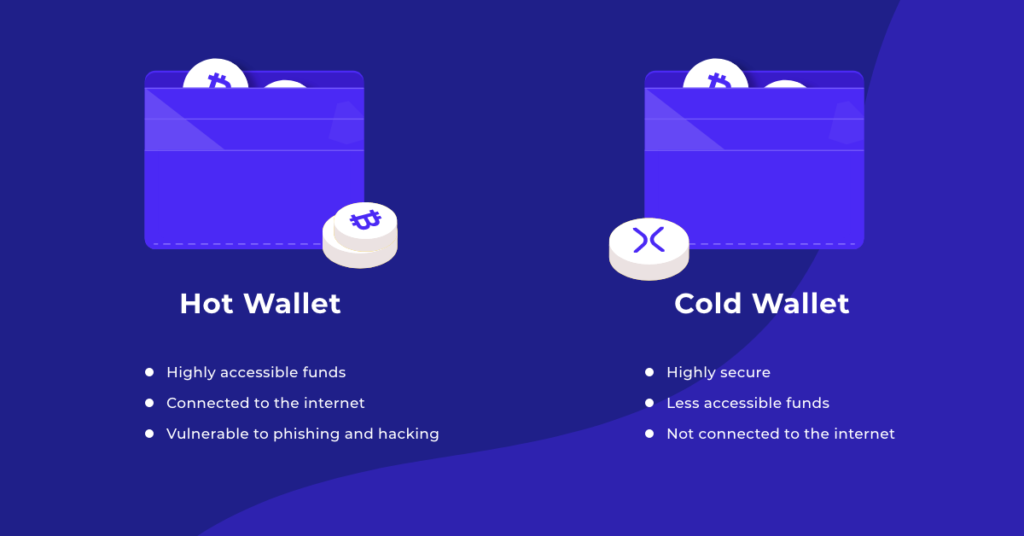
The initial differentiation lies in the categorization of hot wallets and cold wallets. A hot wallet, also known as hot storage, operates as a digital wallet linked to the internet, offering convenience and accessibility. However, this connectivity also renders it more susceptible to hacking, as any device connected to the internet can potentially be targeted by hackers.

Cold storage or cold wallets are wallets devoid of internet connectivity, significantly reducing their susceptibility to hacking. However, this security measure comes with a trade-off: they are less convenient to use. You cannot simply access your cold wallet to send or receive crypto on-demand. Instead, you must physically connect your offline wallet to the internet to execute transactions, disconnecting it afterward.

Software & hardware wallets

Software-hardware-wallets

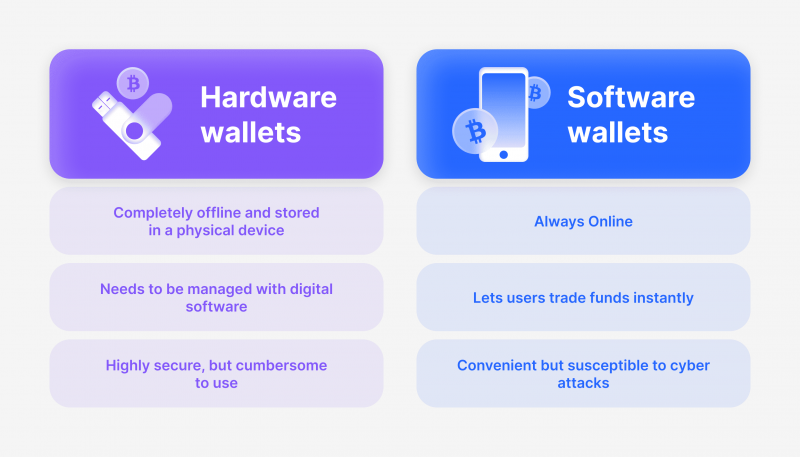
Another differentiation to consider is between software wallets and hardware wallets. Software wallets are digital wallets stored on your computer or mobile device, functioning as computer programs operating atop your device’s operating system. While convenient and user-friendly, they are susceptible to hacking due to the likelihood of your devices being constantly connected to the internet.

A hardware wallet takes the form of a physical device, such as a USB stick, designed to store private keys offline, making it another form of cold storage. Operating on its own operating system, hardware wallets offer significantly enhanced security compared to software wallets.

Custodial & noncustodial wallets

Custodial-noncustodial-wallet

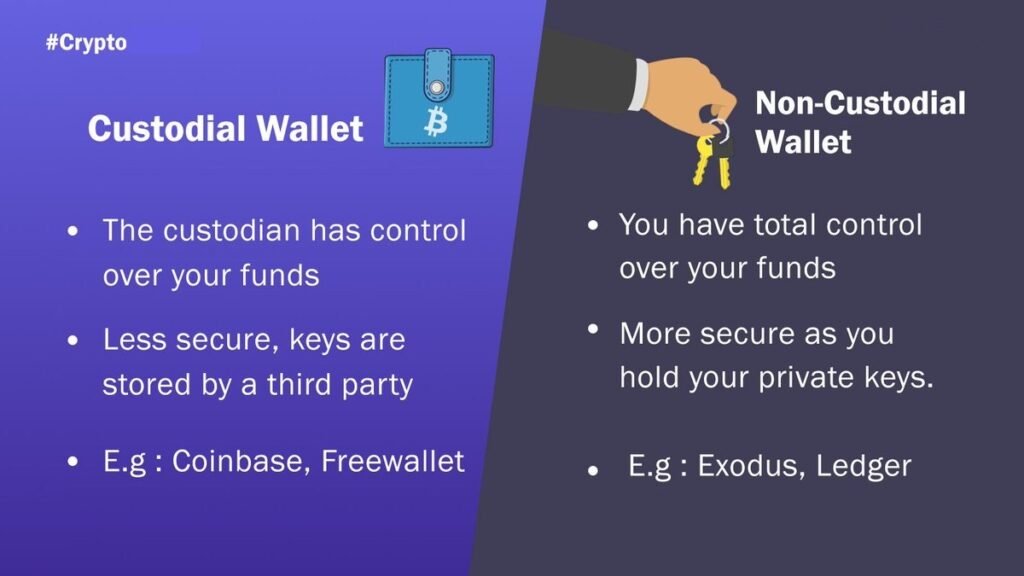
The final differentiation lies in categorizing custodial wallets and noncustodial wallets. Custodial wallets manage and secure your private keys, facilitating transactions and offering access through a standard online user account accessible from any location. However, with custodial wallets, your cryptocurrencies are essentially entrusted to a third party, such as an exchange or a wallet provider, necessitating a significant level of trust on your part.

A custodial wallet ensures the assurance that you won’t face the risk of losing your private key, as you don’t possess it in the first place. Instead, you rely on a password, passphrase, or other standard authentication methods to access your wallet account. In the event of losing or forgetting these credentials, restoring your account is as straightforward as contacting customer service.

On the contrary, noncustodial wallets are under the user’s control, granting full ownership of the private keys. Unlike custodial wallets, they do not store or oversee the management of your keys, greatly reducing the reliance on trust. However, this also implies that if you misplace your private keys, there is no customer service assistance available to aid in account recovery; resulting in permanent loss of your cryptocurrencies.

How to choose the safest wallet for your business

Having familiarized yourself with the various wallet types, how do you determine which one suits your business best? The response to this inquiry hinges on several factors, including the nature of your business, the specific cryptocurrency or cryptocurrencies you intend to utilize (such as Bitcoin, Ether, Litecoin, etc.), the volume of transactions involved, and your level of experience with cryptocurrency.

Choosing between hot and cold storage

In deciding between hot and cold wallets, the determining factors include the volume of cryptocurrency you intend to transact and the frequency of transactions expected. For small businesses handling a limited amount of crypto, a hot wallet may suffice. However, for larger enterprises dealing with substantial funds or intending to hold cryptocurrencies as long-term investments (HODLing), opting for a reliable cold storage crypto wallet is advisable. One of the most reputable cold storage hardware wallets suitable for both businesses and individuals is the Ledger Nano S, renowned for its support of over 700 coins.

Choosing between custodial and noncustodial wallets

For newcomers to the crypto scene lacking transaction experience and proficiency in managing funds, particularly private keys, opting for a custodial wallet like Coinbase Wallet or Exodus is advisable. These user-friendly wallets provide a solid foundation for understanding crypto operations while mitigating concerns about potential losses.

As your business expands and you gain proficiency in crypto operations, transitioning to a noncustodial wallet becomes a viable option, granting complete control over your cryptocurrency holdings.

Specific business-related features to look for in a crypto wallet

Besides choosing a wallet that will keep your cryptos safe, when looking for a crypto wallet for your business, there are a few specific features you might want to keep an eye out for:

  • Multi-signature (multisig) support: This feature allows multiple people to approve a transaction before it’s executed. That way, no single person in your business has control over the funds, therefore reducing the risk of theft.
  • Segregated Witness (SegWit) support: SegWit is a technical improvement of the Bitcoin protocol that allows cheaper and faster transactions. If you plan on frequently moving crypto around, look for a wallet that supports SegWit.
  • Payment Protocol (BIP70-73) support: The Payment Protocol is a set of standards that improve the security and efficiency of Bitcoin transactions. Support for these protocols is important for businesses to make it easier for their customers to pay them.

Risks to look out for when setting up a crypto wallet for your business

The blockchain itself is almost impossible to hack, so your crypto’s vulnerability is mostly related to losing your private key or having it stolen. Even though crypto wallets help in this regard, there are still some risks to keep in mind when setting up a crypto wallet for your business:

  • Hacking: If you’re using a hot wallet connected to the Internet, hackers can gain access to your funds. You can avoid this by using cold storage.
  • Phishing: This is when someone tries to trick you into giving them your private keys or login information by masquerading as a legitimate website or service such as a crypto wallet. To avoid this, double-check every website address you type into your browser and avoid signing up to crypto wallets from a link coming from an untrusted source.
  • Malware attacks: Malicious software designed to steal your crypto can infect your computer or mobile device if you’re not careful. One example is copy-paste malware that detects when you copy a crypto address to the clipboard and replaces it with someone else’s address when you paste it, stealing your funds. You can easily detect these changes by double-checking the address when you paste it before making a transaction.
  • Physical theft: If you’re using a hardware wallet, someone could physically steal it from you and gain access to your crypto. The same goes for those that write their keys on paper. If anyone steals that little piece of paper (or if you lose it), you lose your money.
Conclusion

Setting up a crypto wallet for your business commences with selecting the appropriate option. Optimal security for your business’s cryptocurrencies entails utilizing a cold-storage hardware wallet equipped with essential features like multisig support, SegWit support, and Payment Protocol support. While inherent risks accompany the setup of a crypto wallet for your business, proactive measures can mitigate them. By safeguarding your private key, storing your hardware key in a secure location, and remaining vigilant against potential phishing, hacking, or malware threats, you can harness the numerous business applications of crypto without jeopardizing your funds.

5 Strategies to Grow Your Local Business

0

Introduction

Is your local business feeling stagnant ? Despite your dedication, progressing to the next stage may seem hard. Without a team for collaboration, it’s easy to develop habits that hinder growth. Plus, as the sole decision-maker, you carry full responsibility for your business’s debts and obligations, adding pressure. Additionally, limited resources and knowledge gaps can impede your entrepreneurial journey. Fortunately, implementing proven strategies can overcome these hurdles and propel your business forward. In this article, we  will look into five Strategies to Grow Your Local Business

Here Are 5 Strategies to Grow Your Small Business

Must Read:Strategic Ways To Build A Positive Working environment

1. Take Into Account the Opportunity Cost

Every decision and expense carries the unseen burden of missed opportunities. It’s the potential success foregone when opting for one path over another. Therefore, before fully committing to any endeavor, it’s crucial to pause, reassess, and evaluate the situation. Where do you intend to establish your business presence? Is it prudent to allocate funds now to facilitate future growth, even if it means sacrificing immediate income? Alternatively, can you optimize your current efforts to generate additional revenue without compromising other avenues? Achieving the optimal solution entails striking a balance between time and money. Assess the opportunity cost of each option by weighing the potential benefits of investing time or funds against the opportunities lost elsewhere. By considering both short-term gains and long-term prospects, you can make informed decisions that propel your business forward.

2. Become an expert in your niche

Establishing and dominating a specific segment of the market is crucial for giving your business a competitive edge, consider reinforcing your successful strategies. Emulate what works, enhance your proficiency, and position yourself as a thought the fore-front in your niche. Begin by evaluating your skills and interests, then conduct market research to uncover profitable opportunities. Invest in ongoing education to refine your expertise and foster connections with other leaders in your niche. By focusing on your strengths and leveraging your skills, you can lay the groundwork for long-term success as a small business owner.

3. Outsource Services – 5 Strategies to Grow Your Small Business

Running a successful local business requires a diverse skill set, covering both areas of expertise and tasks where outsourcing may be more beneficial. Failing to tap into external talent can impede your growth trajectory, leading to frustration and overwhelm. Research indicates that over one-quarter of small businesses (27%) primarily outsource to enhance efficiency. Tasks such as marketing, legal affairs, accounting, and operations can easily be delegated to external professionals or vendors. Many service providers specialize in assisting with financial management, company structuring, and legal obligations.

4. Re-evaluate your Goals

Re-evaluate your Goals

As markets evolve and trends shift, even the most well-thought-out plans require adjustments. With numerous tasks competing for attention, prioritization becomes a delicate balance. Thus, refining your goals enables you to discern what truly matters, facilitating prioritization of tasks aligned with these objectives. This approach ensures productive activity, driving meaningful progress with each endeavor. It positions you to adapt strategies to emerging opportunities while staying true to your overarching vision

5. Keep your Business and Personal Finances Separate 

Keep your Business and Personal Finances Separate 

As a business person, while you have the option to open another personal checking account, we strongly recommend maintaining strict financial separation. Avoid mixing personal and business expenses to facilitate easier expense categorization and deductions during tax filing. Additionally, if you withdraw all your business earnings for personal use, your business’s growth potential is constrained. It’s essential to understand that a business’s profit is what remains after compensating yourself, not merely what you withdraw. Ideally, maintain separate banking accounts and acquire a dedicated business credit card, ensuring it’s solely used for business expenses. In the event of accidental business purchases on a personal card, diligently document transactions for reimbursement. By upholding financial segregation, you can effectively monitor profits and allocate funds for strategic investments, pivotal for fostering sustainable growth and expanding your business.

Conclusion

The expansion of your small business hinges on intentional decisions and strategic maneuvers. Central to this endeavor is defining the extent of growth you aspire to achieve. With a clear destination in mind, evaluate the opportunity cost associated with each course of action. Aim to establish yourself as the foremost authority in your niche and harness the benefits of outsourcing to tap into diverse talents. Stay agile by adjusting your goals to align with market dynamics. Lastly, ensure long-term financial security by maintaining distinct boundaries between your business and personal finances.